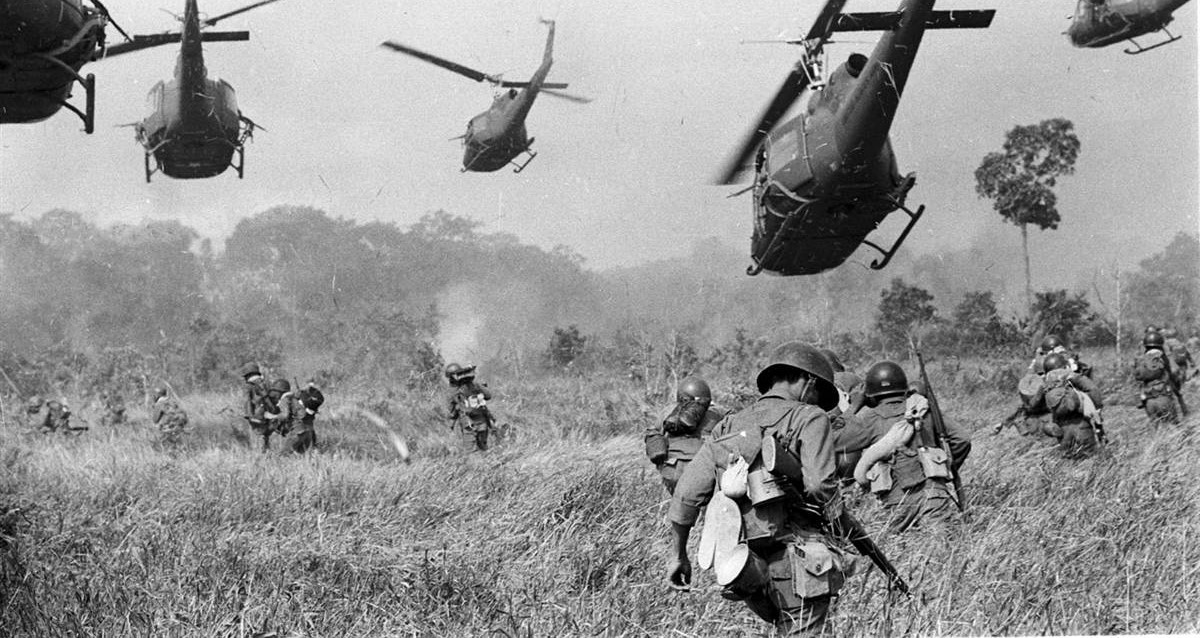
Vietnam’s Costs and Consequences
The War’s Costs
Le Ly Hayslip was born into a peasant family in Central Vietnam in 1949. Her small village was caught in the crossfire of conflict between the French and Moroccan and Viet Minh soldiers, and later between the North Vietnamese and the Viet Cong and the armies of South Vietnam and the United States. The daughter of a rice farmer, Le Ly served as a lookout and messenger for the Viet Cong and planted booby traps for the Viet Cong when she was twelve years old. She was arrested and tortured by the South Vietnamese government police, and then was sentenced to death by the Viet Cong, who accused her of being a government informer. The men assigned to execute her raped her instead.
Like hundreds of thousands of South Vietnamese, Le Ly was displaced from her village by the war. She fled to Danang and then to Saigon, where she became a maid, a waitress in GI clubs, and an attendant in a hospital, before trying, out of desperation, to support herself through black market dealing and prostitution. At the age of twenty, she married an American construction worker and moved to a San Diego suburb, where she later wrote a harrowing account of her life, When Heaven and Earth Changed Places.
An estimated 58,132 Americans died in Vietnam. More than 150,000 were wounded, and 21,000 were permanently disabled. More than three million Americans, average age nineteen, served in the Vietnam War. An estimated 100,000 Americans fled the United States to avoid serving in the conflict, and approximately 50,000 American servicemen deserted. The Veterans Administration estimates that 830,000 Vietnam vets suffered symptoms of post-traumatic stress disorder. Of that number, 480,000 were so deeply affected that they were considered disabled. Several hundred thousand American troops were exposed to defoliants, such as, Agent Orange. The estimated cost of the war in Vietnam during the Kennedy, Johnson, and Nixon administrations was $176 billion. As a whole, sixty percent of all draft-age American men did not serve in the military between 1963 and 1974, and 98 percent did not see combat.
The war’s greatest costs and suffering were borne by the Vietnamese people, who may have lost two million lives during the conflict. Hundreds of thousands of South Vietnamese were displaced from rural villages, and their families splintered. Herbicides and bombs ravaged the countryside. Between 1964 and 1969, the United States dropped more than nine times the tonnage of high explosives on Vietnam as it did in the Pacific theater during World War II.
After the war, North Vietnam detained 50,000 to 100,000 former supporters of the Saigon regime in re-education camps. Over a million “boat people,” consisting largely of Vietnam’s persecuted Chinese minority, fled the country to avoid persecution.
The War’s Consequences
The Vietnam War had far-reaching consequences for the United States. It led Congress to replace the military draft with an all-volunteer force and the country to reduce the voting age to eighteen. It also inspired Congress to attack the “imperial” presidency through the War Powers Act, restricting a president’s ability to wage war without explicit Congressional approval. Meanwhile, hundreds of thousands of Vietnamese refugees have helped restore blighted urban neighborhoods.
The Vietnam War severely damaged the U.S. economy. Unwilling to raise taxes to pay for the war, President Johnson unleashed a cycle of inflation.
The war also weakened U.S. military morale and undermined, for a time, the U.S. commitment to internationalism. The public was convinced that the Pentagon had inflated enemy casualty figures, disguising the fact that the country was engaged in a military stalemate. During the 1970s and 1980s, the United States was wary of getting involved anywhere else in the world out of fear of another Vietnam. Since then, the public’s aversion to casualties inspired strict guidelines for the commitment of forces abroad and a heavy reliance on air power to project American military power.
The war in Vietnam deeply split the Democratic Party. As late as 1964, over sixty percent of those surveyed identified themselves in opinion polls as Democrats. The party had won seven of the previous nine presidential elections. But the prosecution of the war alienated many blue-collar Democrats, many of whom became political independents or Republicans. To be sure, other issues—such as urban riots, affirmative action, and inflation—also weakened the Democratic Party. Many former party supporters viewed the party as dominated by its anti-war faction, weak in the area of foreign policy, and uncertain about America’s proper role in the world.
Equally important, the war undermined liberal reform and made many Americans deeply suspicious of government. President Johnson’s Great Society programs competed with the war for scarce resources, and constituencies who might have supported liberal social programs turned against the president as a result of the war. The war also made Americans, especially the baby boomer generation, more cynical and less trusting of government and of authority.
Today, decades after the war ended, the American people remain deeply divided over the conflict’s meaning. A Gallup Poll found that 53 percent of those surveyed believe that the war was “a well-intentioned mistake,” while 43 percent believe it was “fundamentally wrong and immoral.”
Chronology
1941: Ho Chi Minh forms the Viet Minh.
1946: Viet Minh forces attack a French garrison in Hanoi beginning the first Vietnam War.
1950: President Truman’s National Security Council decides to provide military aid for the French war in Indochina.
1954: Following the French defeat at Dien Bien Phu, an agreement is reached splitting Vietnam at the 17th parallel into a Communist North and a non-Communist South, pending nationwide elections in 1956.
1955: Ngo Dinh Diem proclaims the Republic of South Vietnam and becomes its president.
April 1959: President Dwight D. Eisenhower commits the United States to maintaining South Vietnam’s independence.
July 1959: Two U.S. advisors are the first Americans killed in a guerrilla attack 20 miles north of Saigon.
April 1960: North Vietnam begins mandatory military service as its troops infiltrate South Vietnam.
By year’s end, about 900 U.S. military personnel are in Vietnam.
November 1960: Democrat John F. Kennedy defeats Republican Richard M. Nixon for president.
December 1960: The National Liberation Front (the Viet Cong) is proclaimed.
May 1961: Kennedy sends 100 Special Forces troops, trained for guerrilla warfare, to Vietnam.
December 1961: Secretary of State Dean Rusk says South Vietnam is in “clear and present danger” of Communist conquest.
February 1962: More American advisors and support personnel arrive. Kennedy warns that American advisors will return fire if attacked.
May 1962: In response to Communists moving into Laos, U.S. sends 5,000 Marines and 50 fighter jets to Thailand.
October 1962: U.S. discovers Soviet missile sites under construction in Cuba. Soviets agree to remove missiles, but crisis heightens fears of superpower conflict.
January 1963: In battle of Ap Bac, South Vietnamese and Americans suffer worst defeat to date: five U.S. helicopters downed and three Americans killed.
August 1963: Rev. Martin Luther King Jr. delivers his “I Have a Dream” speech during civil rights march in Washington.
November 1963: South Vietnamese generals kill President Ngo Dinh Diem in a plot condoned by key American officials who felt Saigon could not win under his leadership. Three weeks later, Kennedy is assassinated. Vice President Lyndon B. Johnson succeeds him.
1964: North Vietnam begins infiltrating its regular army units into the South.
August 1964: The Maddox, a U.S. destroyer, is slightly damaged by enemy boats in the Tonkin Gulf. After a reported second attack—which many later concluded did not occur—Congress passes Gulf of Tonkin Resolution, giving Johnson authority to intensify the war.
October 1964: China explodes its first atomic bomb.
November 1964: Johnson elected in landslide over Republican Barry Goldwater, who had pushed for an even tougher approach to Vietnam.
December 1964: Bob Hope begins frequent visits to entertain the troops.
January 1965: Johnson sends Congress a budget containing the biggest expansion of domestic welfare programs since the New Deal, reflecting his goal of providing funds for both the war and what was called the Great Society.
February 1965: Viet Cong attack an American airfield at Pleiku. U.S. bombers attacked targets in North for the first time, in a reprisal for attacks on U.S. bases.
March 1965: First U.S. combat troops in South Vietnam land in Da Nang.
April 1965: As Johnson formally authorizes combat troops to be used for offensive operations, antiwar protestors become more active.
August 1965: Large scale race rioting, resulting from the arrest of a black motorist by a white officer, leaves 34 dead in Watts section of Los Angeles.
October 1965: Antiwar sentiment continues to build; protests held in 40 U.S. cities.
December 1965: American troop strength reaches 184,300; to date there are 636 U.S. deaths.
January 1966: Congress is asked for $12.8 billion to help finance the war; merits of the war are debated in Congress, but the money is eventually approved.
June 1966: Johnson expands bombing to oil installations in Hanoi and Haiphong.
Summer 1966: Race riots break out in Chicago and several other northern cities. Riots escalate a year later.
September 1966: The United States announces that it is using chemicals to destroy enemy’s jungle cover, thus introducing the herbicide Agent Orange into the conflict; thousands of American soldiers later say they developed cancer and other afflictions as a result of exposure.
April 1967: Boxing champion Muhammad Ali refuses induction into the armed forces, citing religious reasons. He tells reporters, “I ain’t got no quarrel with them Viet Cong.”
October 1967: At least 50,000 protesters march on Pentagon. For first time, opinion polls find more Americans are against the war than support it.
November 1967: Democrat Eugene McCarthy announces that he will run as a presidential candidate dedicated to ending the war.
December 1967: U.S. military personnel in Vietnam reach 485,600; 16,021 killed to date.
January 1968: North Vietnam launches massive Tet offensive, reaching all the way to U.S. Embassy in Saigon; despite heavy communist casualties, public relations victory goes to Hanoi, fueling antiwar movement.
February 1968: Viet Cong and North Vietnamese kill 2,800 civilians in Hue. U.S. casualty rate reaches weekly high: 543 killed.
March 1968: Johnson announces he will not seek reelection. My Lai massacre of South Vietnamese civilians by American troops leaves hundreds of unarmed civilians dead.
April 1968: Rev. King, who had called for total withdrawal from Vietnam, is assassinated.
May 1968: Moves toward peace bring first substantive meeting between U.S. and North Vietnam in Paris. Bloodiest month of the war for U.S. casualties, 2,371 Americans killed.
June 1968: Robert F. Kennedy, a Democratic presidential candidate opposed to the escalation of the war in Vietnam, is assassinated.
August 1968: Violence erupts between police and antiwar demonstrators at Democratic convention in Chicago.
November 1968: Richard Nixon, who vowed to achieve peace with honor in Vietnam, defeats Democrat Hubert H. Humphrey in presidential election.
May 1969: The Unites States proposes peace plan calling for troop withdrawal by both sides.
June 1969: Nixon announces that U.S. troops will begin unilateral withdrawal.
July 1969: Apollo 11 astronauts land on the moon.
August 1969: Woodstock festival, a social and musical milestone, draws an estimated 500,000 to upstate New York.
September 1969: North Vietnamese Leader Ho Chi Minh dies in Hanoi; successor pledges to continue war.
November 1969: Details of the My Lai massacre become public.
December 1969: First Vietnam War draft lottery, tying mandatory military service to date of birth, is held in U.S.
February 1970: National Security Advisor Henry A. Kissinger begins secret peace talks in Paris; Nixon later appoints him secretary of State.
March 1970: The United States begins bombing North Vietnamese sanctuaries and supply routes in Cambodia.
April 1970: U.S. and South Vietnamese troops invade Cambodia in effort to cripple enemy supply lines; it is last big operation of the war for the United States.
May 1970: Four students killed by National Guardsmen during antiwar protest at Kent State University in Ohio.
December 1970: Congress prohibits using troops or advisors in Cambodia and Laos.
March 1971: Lt. William L. Calley Jr. convicted of premeditated murder in the My Lai massacre.
June 1971: New York Times begins publishing top-secret Pentagon Papers, which explored the U.S. decision-making process regarding South Vietnam.
July 1971: The 26th Amendment lowers the voting age to 18.
November 1971: Nixon announces that U.S. ground forces have taken a defensive role, leaving offensive attacks to the South Vietnamese.
December 1971: U.S. military strength declines to 156,800. U.S. death toll, 45,626.
March 1972: North Vietnam begins a full-scale invasion of the South.
April 1972: In effort to pressure Hanoi on lagging peace talks, bombing of Hanoi and Haiphong resumes after four-year lull.
June 1972: Five men seized while breaking into the Democratic National Committee headquarters at the Watergate building in Washington.
July 1972: Actress Jane Fonda, an anti-war activist, goes to Hanoi on a fact-finding mission, poses for pictures with North Vietnamese soldiers, and becomes target of criticism in U.S.
October 1972: National Security Advisor Henry Kissinger announces, “Peace is at hand.” His announcement of a tentative accord turns out to be premature.
November 1972: Nixon wins second term, defeating Democrat George S. McGovern.
December 1972: The North Vietnamese walk out of the Paris peace talks; American bombers strike at Hanoi and Haiphong.
January 1973: The United States, South Vietnam, the Viet Cong, and North Vietnam sign a cease-fire agreement.
March 1973: Last U.S. ground troops leave Vietnam.
November 1973: Congress overrides presidential veto of War Powers Act, which limits president’s ability to wage war without congressional approval.
January 1974: North Vietnam orders major offensive to “liberate” South Vietnam.
April 1974: Cambodia falls to Communist Khmer Rouge rebels, who begin program of genocide that kills more than a million Cambodians.
August 1974: Nixon resigns in Watergate scandal and is succeeded by Vice President Gerald R. Ford.
September 1974: Ford offers clemency to Vietnam draft evaders and military deserters.
April 29, 1975: Last U.S. military personnel killed, in a rocket attack.
April 30, 1975: North Vietnamese capture Saigon, ending the Vietnam War.
July 1975: North Vietnam annexes South Vietnam and disbands the National Liberation Front.
December 1978: Vietnam invades Cambodia and occupies the country for a decade.
November 1982: The Vietnam Memorial in Washington is dedicated.
February 1994: The United States ends its 19-year trade embargo against Vietnam.
July 1995: The United States extends full diplomatic recognition to Vietnam.
Key Figures
Vo Nguyen Giap: Architect of North Vietnam’s military victory
Ho Chi Minh: Revered in North as father of the country
Ngo Dinh Diem: South Vietnamese President assassinated by his generals
Nguyen Cao Ky: Air force officer helped lead South Vietnam in the post-Diem era
Nguyen Van Thieu: Resigned South Vietnamese presidency shortly before war’s end
Lyndon Johnson: Inherited presidency and unpopular war
Richard Nixon: Took office after nation had turned against the war
William C. Westmoreland: Controversial U.S. commander
William Calley: Platoon leader found guilty in My Lai massacre. He was sentenced first to life, then to ten years, in prison. He was freed by order of a civil court in 1974.
Robert McNamara: As defense chief, guided U.S. policy
Henry C. Lodge: Pushed air war in role as envoy and presidential advisor