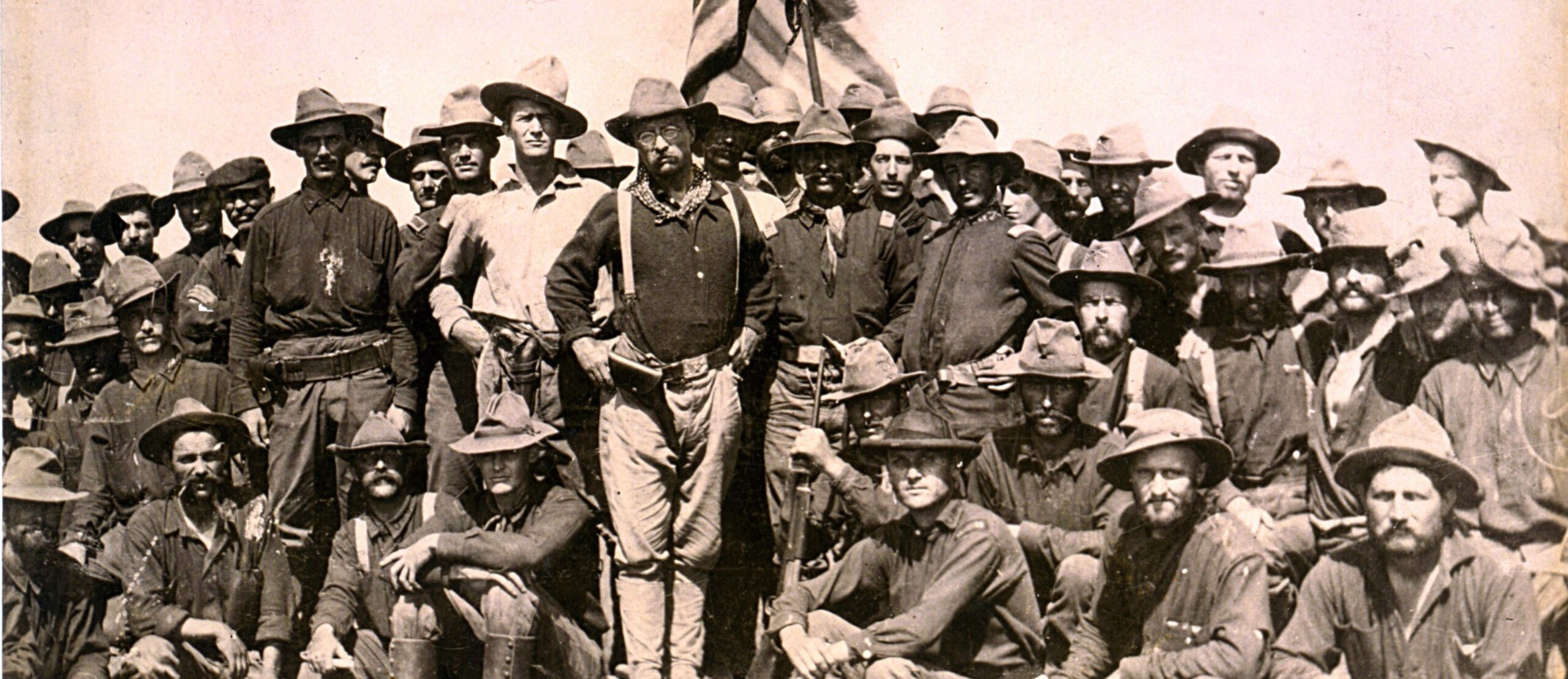
A Shift in U.S. Foreign Policy
“A Man, A Plan, A Canal, Panama”
At noon on December 31, 1999, the United States voluntarily gave up the Panama Canal, ending 85 years of control. Prior to the development of the atomic bomb and the landing of astronauts on the moon, the Panama Canal was perhaps this country’s signal engineering achievement. Fifty-one miles long, with about $3.5 billion in bases and infrastructure, the canal links the Atlantic and Pacific oceans.
At the end of the twentieth century, the canal was no longer essential to U.S. strategic or economic interests. Aircraft carriers and oil tankers were too large to pass through the canal’s locks. Earlier in the century, however, the canal was regarded as a vital national interest. During World War II, the United States stationed 65,000 troops in Panama to protect the canal. A number of U.S. interventions in the Caribbean and Central America were undertaken largely to protect the canal from hostile powers.
The canal’s construction was a phenomenal undertaking. In 1850, U.S. interests in Panama built a railroad across the Isthmus to transport ’49ers to California. In 1879, the French, fresh from their success in building the Suez Canal, started building the canal. Over the next twenty years, between 16,000 and 22,000 workers died from malaria, yellow fever, typhoid, snake bites, and accidents. Torrential rains averaging 200 inches a year washed away much of the work.
America’s 1898 war with Spain made a canal seem essential. During the Spanish American War, the only way for U.S. battleships to sail from the Atlantic to the Pacific Ocean was to make an 8,000-mile journey around Cape Horn at the tip of South America.
The canal was completed in the face of seemingly insurmountable political, medical, and technological obstacles. The Isthmus of Panama was located in Colombia, which had rejected a U.S. proposal to build a canal. “You could no more make an agreement with them than you could nail currant jelly to a wall,” President Theodore Roosevelt said in response to the rejection.
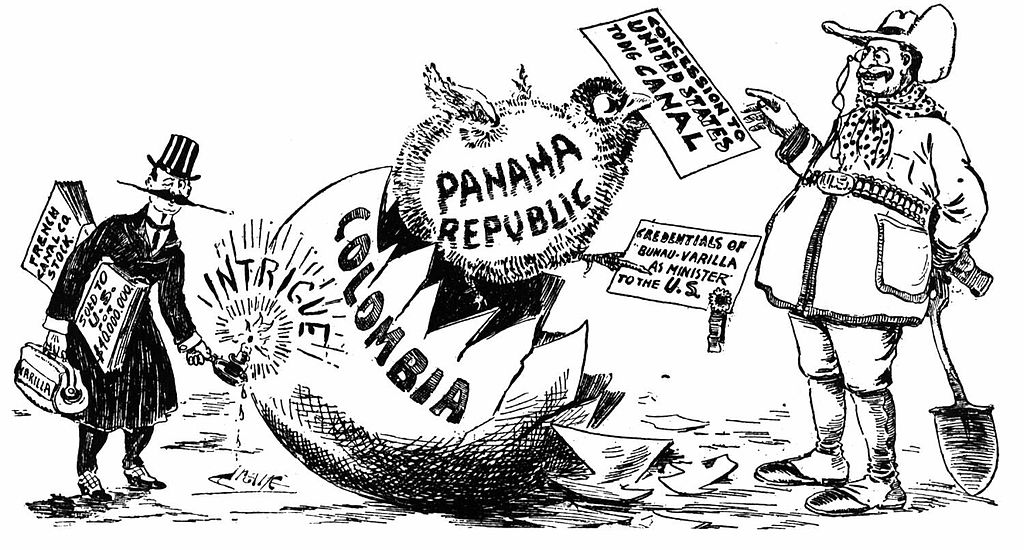
A French adventurer, Philippe Bunau-Varilla, and an American lawyer, Nelson Cromwell, conceived of the idea of creating the Republic of Panama. They persuaded Roosevelt to support a Panama revolt. Bunau-Varilla engineered a revolution and U.S. warships prevented Colombia from stopping Panama’s attempt to break away. In 1921, the U.S. paid an indemnity to Colombia in recognition of the U.S. role in the Panamanian revolution. Bunau-Varilla repaid the United States for its assistance by signing a treaty on behalf of the Panamanians, which gave the United States a zone stretching five miles from each bank of the canal in perpetuity. Within the zone, U.S. laws, police, and courts ruled.
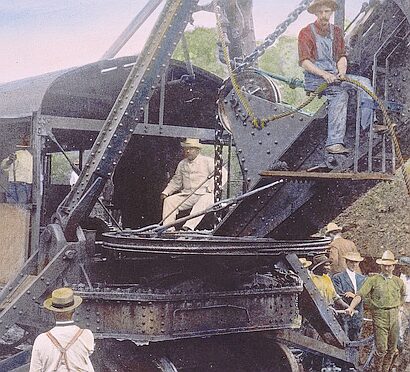
Years later, President Roosevelt said that the people of Panama rebelled against Colombia “literally as one man.” A senator quipped, “Yes, and the one man was Roosevelt.” In 1911, Roosevelt said bluntly, “I took the Isthmus, started the canal and then left Congress not to debate the canal but to debate me.” In 1906, eager to see the greatest accomplishment of his presidency, he became the first president to travel overseas. He went to Panama at the height of the rainy season and took the controls of a 95-ton steam shovel.
During the construction of the canal, William Gorgas, an army physician, tried to reduce the number of deaths caused by disease. He oversaw the massive draining of swamps in order to eliminate mosquitoes that carried yellow fever and malaria.
The French had attempted to build a canal at sea level, but grossly underestimated the difficulty of achieving this goal. To allow ships to travel between the oceans, American engineers designed a system of locks capable of raising and lowering ships 64 feet by using the force of gravity and 40-horsepower motors to move the gates. One set of locks used enough concrete to build a wall eight-feet thick and twelve-feet high, stretching between Cleveland and Pittsburgh.
At its peak in 1913, the workforce consisted of 44,000 persons. West Indian workers were the canal’s unsung heroes. Each day, 200 trainloads of dirt had to be hauled away. More than 25,000 worked as canal diggers—three times the number of Americans who worked on the canal. Between 1904 and 1915, some 5,600 lives were lost to disease and accidents. Most of those who died were from Barbados. The quinine used to treat malaria left many workers deaf. In December 1908, a massive twenty-two tons of dynamite exploded prematurely, killing twenty-three workers.
Built at a cost of $387 million over a period of ten years, the 51-miles long Panama Canal was a declaration of America’s coming of age in the world and one of the engineering marvels of the modern world. The product of political intrigue, the canal was also a pioneering example of the success of modern medicine in addressing the challenges of such endemic tropical diseases as malaria and yellow fever. Constructing the canal ultimately took fourteen years over three presidential administrations.
The United States Becomes a World Power
By 1890, the United States had by far the world’s most productive economy. American industry produced twice as much as its closest competitor—Britain. But the United States was not a great military or diplomatic power. Its army numbered less than 30,000 troops, and its navy had only about 10,000 seamen. Britain’s army was five times the size of its American counterpart, and its navy was ten times bigger. The United States’ military was small because the country was situated between two large oceans and was surrounded by weak or friendly nations. It faced no serious military threats and had little interest in asserting military power overseas.
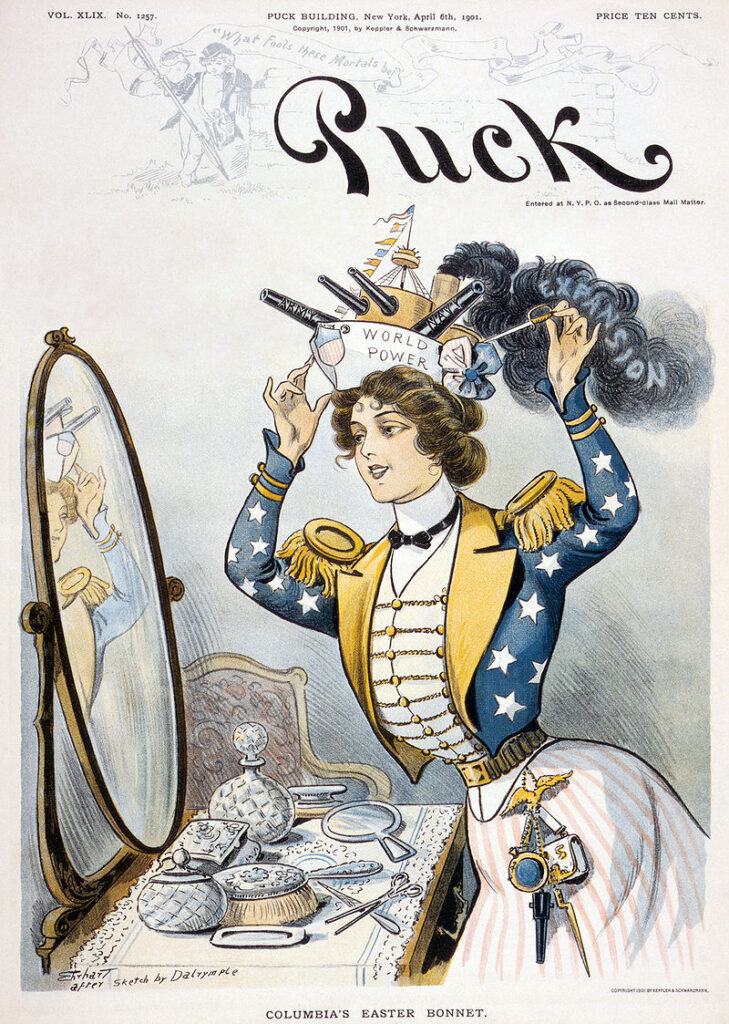
From the Civil War until the 1890s, most Americans had little interest in territorial expansion. William Seward, the Secretary of State under presidents Lincoln and Johnson, did envision American expansion into Alaska, Canada, Mexico, Central America, the Caribbean, Iceland, Greenland, Hawaii, and other Pacific islands. But, he realized only two small parts of this vision. In 1867, the United States purchased Alaska from Russia for $72 million and occupied the Midway Islands in the Pacific.
Americans resisted expansion for two major reasons. One was that imperial rule seemed inconsistent with America’s republican principles. The other was that the United States was uninterested in acquiring people with different cultures, languages, and religions. Where an older generation of moralists thought that ruling a people without their consent violated a core principle of republicanism, a younger generation believed that the United States had a duty to uplift backward societies.
By the mid-1890s, a shift had taken place in American attitudes toward expansion that was sparked partly by a European scramble for empire. Between 1870 and 1900, the European powers seized ten million square miles of territory in Africa and Asia, a fifth of the world’s land mass. About 150 million people were subjected to colonial rule. In the United States, a growing number of policy makers, bankers, manufacturers, and trade unions grew fearful that the country might be closed out in the struggle for global markets and raw materials.
A belief that the world’s nations were engaged in a Darwinian struggle for survival and that countries that failed to compete were doomed to decline also contributed to a new assertiveness on the part of the United States. By the 1890s, the American economy was increasingly dependent on foreign trade. A quarter of the nation’s farm products and half its petroleum were sold overseas.
Alfred Thayer Mahan, a naval strategist and the author of The Influence of Sea Power Upon History, argued that national prosperity and power depended on control of the world’s sea-lanes. “Whoever rules the waves rules the world,” Mahan wrote. To become a major naval power, the United States began to replace its wooden sailing ships with steel vessels powered by coal or oil in 1883. But control of the seas would also require the acquisition of naval bases and coaling stations. Germany’s Kaiser Wilhelm had copies of Mahan’s books placed on every ship in the German High Seas Fleet and the Japanese government put translations in its imperial bureaus.
During the late nineteenth century, the idea that the United States had a special mission to uplift “backward” people around the world also commanded growing support. The mainstream Protestant religious denominations established religious missions in Africa and Asia, including 500 missions in China by 1890.
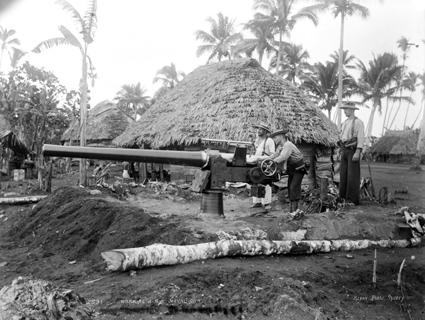
During the late 1880s, American foreign policymakers began to display a new assertiveness. The United States came close to declaring war against Germany over Samoa in 1889, against Chile in 1891, over the treatment of U.S. sailors, and against Britain in 1895, over a territorial dispute between Venezuela and Britain.
American involvement in the overthrow of Hawaii’s monarchy in 1893 precipitated a momentous debate over the United States’ global role. Americans debated whether the U.S. should behave like a great power and seize colonies or whether it should remain something different.