Technological Innovation
Accelerating Transportation
At the outset of the nineteenth century, the lack of reliable, low-cost transportation was a major barrier to American economic development. The stagecoach, slow and cumbersome, was the main form of transportation. Twelve passengers, crowded along with their bags and parcels, traveled at just four miles an hour. In Connecticut and Massachusetts, Sunday travel was still forbidden by law.
Wretched roads plagued travelers. Larger towns had roads paved with cobblestones. On major highways, potholes were filled with stones. But, most roads were simply dirt paths left muddy and rutted by rain. The presence of tree stumps in the middle of many roads posed a serious obstacle to carriages. Charles Dickens aptly described American roads as a “series of alternate swamps and gravel pits.”
In addition, the cost of overland transportation remained prohibitively high. It cost more to transport a ton of freight 300 miles over land than to ship it from Philadelphia to Europe. In New Jersey, a one horse cart charged three cents a mile.
In 1791, builders first inaugurated a new era in transportation with the construction of a 66-mile long turnpike between Philadelphia and Lancaster, Pennsylvania. This stimulated a craze for toll road construction. By 1811, 135 private companies in New York had invested $7.5 million in 1,500 miles of road. By 1838, Pennsylvania had invested $37 million to build 2,200 miles of turnpikes.
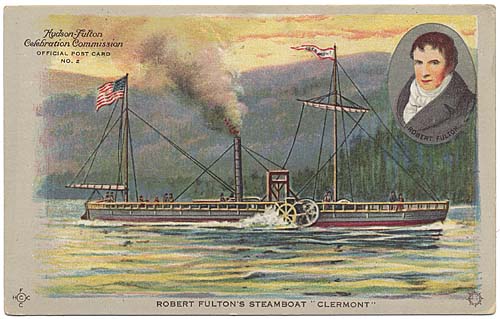
Despite the construction of turnpikes, the cost of transporting freight over land remained onerous. It cost at least fifteen cents to move a ton of goods a mile. Because water transportation was cheaper, farmers often shipped their produce down the Mississippi, Potomac, or Hudson rivers by flatboat or raft. Unfortunately, water transportation was slow and few vessels were capable of going very far upstream. The trip downstream from Pittsburgh to New Orleans took a month; the trip upstream against the current took four months. Steam power offered the obvious solution, and inventors built at least sixteen steamships before Robert Fulton successfully demonstrated the commercial practicality of steam navigation. In 1807, he sailed a 160-ton side wheeler, the Clermont, 150 miles from New York City to Albany in only 32 hours. “Fulton’s folly,” as critics mockingly called it, opened a new era of faster and cheaper water transportation.
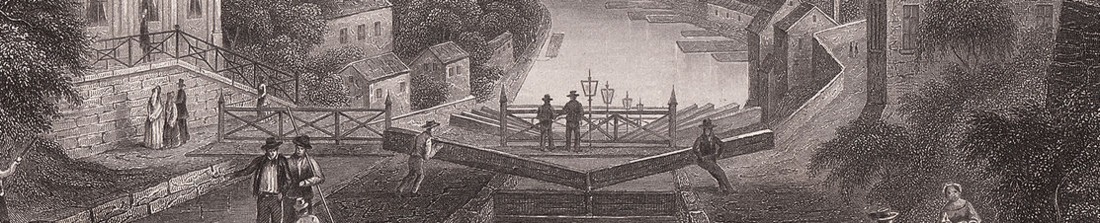
Water transportation was further revolutionized by the building of canals. Prior to the War of 1812, construction companies had built scarcely 100 miles of canals. Construction costs ran $25,000 to $80,000 per mile. But the spectacular success of the Erie Canal touched off an enormous wave of canal construction.
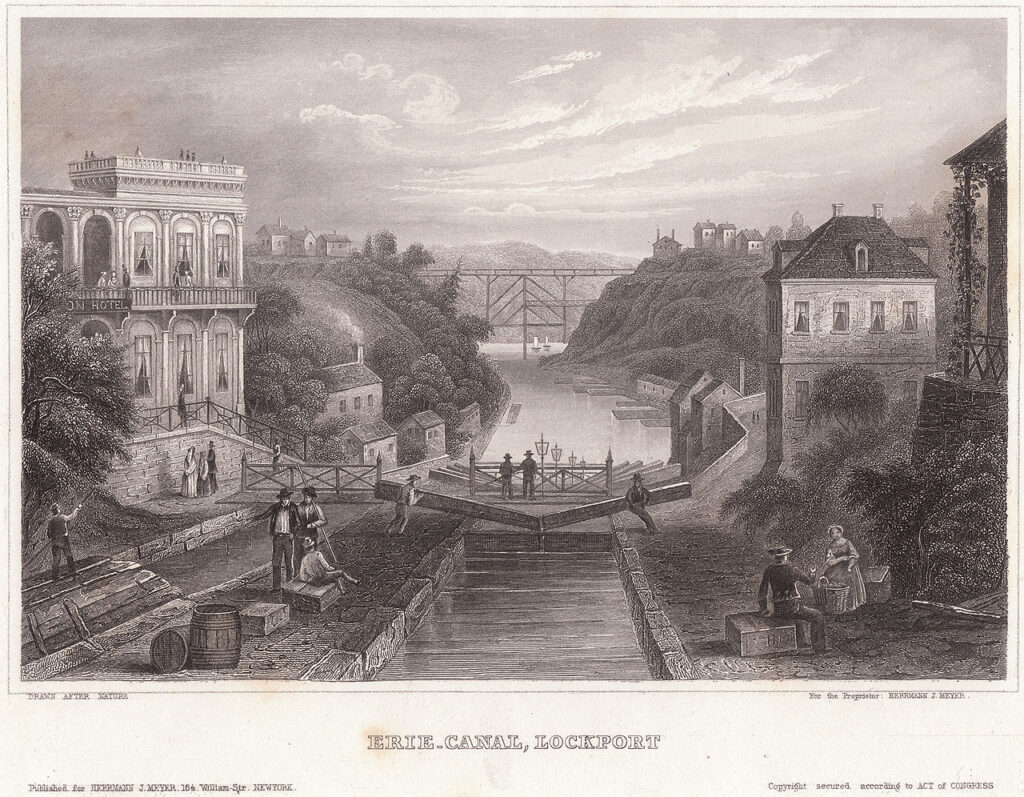
On Wednesday, October 25, 1825, the state of New York opened the Erie Canal, which connected the Great Lakes to the Atlantic Ocean. To celebrate the opening, New Yorkers fired cannons, placed at eight mile intervals along the 364-mile length of the canal. The canal was a stupendous engineering achievement. Three thousand workers, using hand labor, toiled for eight years to build the canal. They had cut through forests, dug through rock, and built over mosquito infested swamps. They built 84 locks, each 15 feet wide and 90 feet long, to raise or lower barges 10 feet at a time. They even raised a river 9 feet with a 900-foot dam and built 18 aqueducts, one more than 800 feet long over rivers and valleys.
Perhaps, the most impressive was the fact that the Erie Canal was built by four principal engineers who had never seen a canal. Lacking modern engineering tools, they designed the canal “by guess and by God.”
The canal was built in the face of intense opposition. Thomas Jefferson said that “making a canal 350 miles through a wilderness is little short of madness.” President James Madison vetoed a bill that would have provided federal land grants to help New York with the project. Nevertheless, despite scoffing at the project known as “Clinton’s Ditch” named after the canal’s chief backer, Governor DeWitt Clinton, the engineers, diggers, and political leaders and voters in New York persisted. Altogether, roughly 85 percent of the capital for the Erie Canal came from the New York state government and local governments along the route.
The “big ditch” sparked an economic revolution. Before the canal was built, it cost one hundred dollars and took twenty days to transport a ton of freight from Buffalo to New York City. After the canal was opened, the cost fell to five dollars a ton and transit time was reduced to six days. By 1827, as a result of the canal, wheat from central New York state could be bought for less in Savannah, Georgia, than wheat grown in Georgia’s interior.
The success of the Erie Canal led other states to embark on expensive programs of canal building. Pennsylvanians, aware that it cost more to transport goods 150 miles within their state than it did for New Yorkers to ship goods 750 miles between New York City and Ohio, spent $10 million to build a canal between Philadelphia and Pittsburgh. Illinois, Indiana, and Ohio launched projects to connect the Ohio and Mississippi rivers to the Great Lakes. By 1840, 3,326 miles of canals had been dug at a cost of $125 million.
Cities like Baltimore and Boston, which were unable to reach the West with canals experimented with the railroad, a novel form of transportation. At first, a railroad was simply a highway lined with a double track of wood rails along, which a horse or mule pulled a stagecoach or wagon. In 1829, the Delaware and Hudson Canal Company imported two English steam locomotives but found the engines too heavy for American rails and trestles. Finally, in 1830 the first American built locomotives were put into regular operation on the Baltimore and Ohio, Charleston and Hamburg, and Mohawk and Hudson railroads.
These early railroads suffered from nagging engineering problems and vociferous opposition. The first rails were simply wooden beams with a metal strip nailed to the surface. The strips frequently curled up, cutting through the train’s floor. Brakes were wholly inadequate, consisting of wooden blocks operated by a foot pedal. Boilers exploded so frequently that passengers had to be protected by bales of cotton. Engine sparks set fire to fields and burned unprotected passengers. One English traveler counted thirteen holes burned in her dress after a short ride.
Opposition to railroads was widespread. Vested interests, including turnpike and bridge companies, stagecoaches, ferries, and canals, sought laws to prohibit trains from carrying freight. A group of Boston doctors warned that bumps produced by trains traveling at fifteen or twenty miles per hour would lead to many cases of “concussion of the brain.” An Ohio school board declared that “such things as railroads … are impossibilities and rank infidelity.”
In spite of such objections, it quickly became clear after 1830 that railroads were destined to become the nation’s chief means of moving freight. During the 1830s, construction companies laid down 3,328 miles of track, roughly equal to all the miles of canals in the country. With an average speed of ten miles an hour, railroads were faster than stagecoaches, canal boats, and steamboats, and, unlike water going vessels, could travel in any season.
The transportation revolution sharply reduced the cost of shipping goods to market and stimulated agriculture and industry. New roads, canals, and railroads speeded the pace of commerce and strengthened ties between the East and West.
Speeding Communications
Poor communications had also impeded development. During the 1790s, it took three weeks for a letter to travel from New York to Cincinnati or Detroit and four weeks to arrive in New Orleans. In 1799, it took one week for news of George Washington’s death to reach New York City from Virginia. A decade and a half later, it still took forty-nine days for word of the peace treaty ending the War of 1812 to reach New York from London.
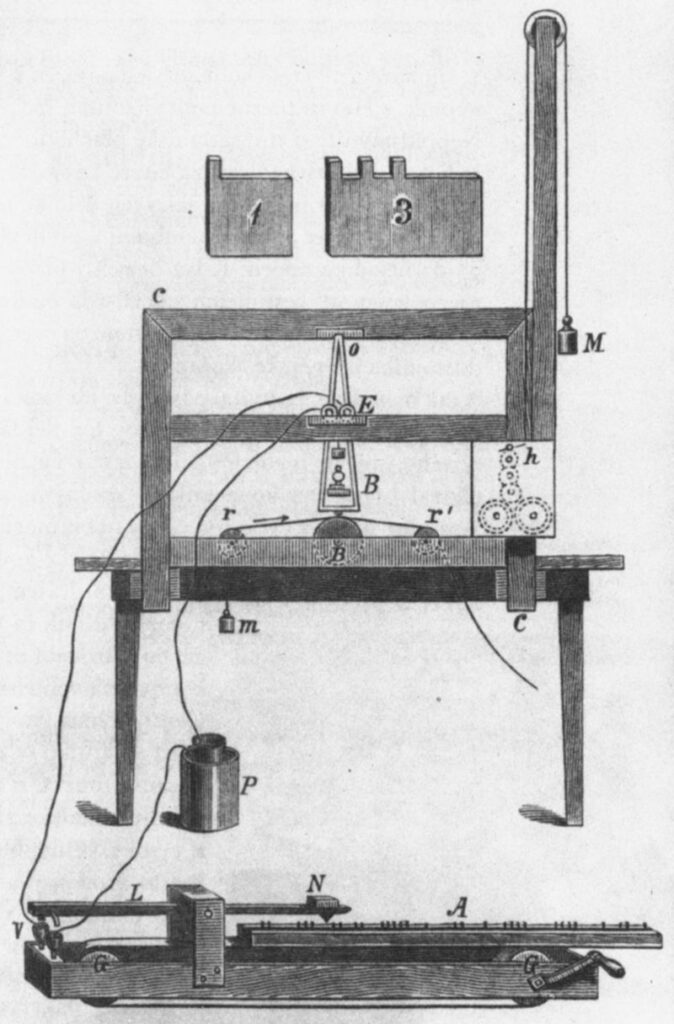
By the early 1830s, a decade before Samuel F.B. Morse invented the telegraph, the transmission of information had improved considerably as a result of improved roads and faster sailing ships. In 1831, it took just 15.5 hours for the text of Andrew Jackson’s State of the Union address to travel from Washington to New York eight times faster than in 1799. By 1841, a letter traveled between New York and New Orleans in nine days and between New York and Cincinnati in five days, three times faster than in 1815.
The volume of information transmitted also increased considerably. In 1790, the United States had just 92 newspapers, with a total annual circulation of less than four million. By 1820, the number of papers published had jumped to 512, with an annual circulation of 50 million. By 1835, there were 1,258 newspapers in the United States with a circulation of over 90 million. When Alexis de Tocqueville, a French observer, visited the United States in 1831, he was shocked at the amount of information available even in frontier regions: “I do not think that in the most enlightened rural districts of France there is an intellectual movement either so rapid or on such a scale as in this wilderness.”
Resistance to Technological Innovation
At the beginning of the nineteenth century, a lack of skilled mechanics, an inadequate system of higher education, and widespread resistance to technological innovation also hampered economic progress. The United States lagged far behind Europe in the practical application of science and technology. There was probably just one steam engine in regular operation in the United States in 1800, one hundred years after simple engines had first been used in Europe. Ten years after the first cotton mill opened in the United States in 1791, only eight cotton mills operated in the country. Inventors, like Oliver Evans, designer of an early locomotive, and John Fitch, creator of the first American steamboat, failed because they were unable to finance their projects or persuade the public to use their inventions.
The lack of skilled mechanics presented a particularly severe barrier to innovation. In 1805, when Robert Fulton wanted to build a torpedo, he could find only one mechanic in New York who could follow his plans, a Frenchman who spoke virtually no English. Two years later, when he needed an engine to propel the Clermont up the Hudson River, he had to import a steam engine from England, since American craftsmen could not construct such a complicated machine.
The inadequate state of higher education also slowed technological innovation. At the beginning of the nineteenth century, Harvard, the nation’s most famous college, graduated just 39 men a year. Noah Webster, author of the nation’s first dictionary, admitted grudgingly: “Our learning is superficial in shameful degree … our colleges are disgracefully destitute of books and philosophical apparatus.”
By the 1820s, however, the United States had largely overcome resistance to technological innovation. When Friedrich List, a German traveler, visited the United States in the 1820s, he was astonished by the amount of public interest in technology. “Everything new is quickly introduced here,” List wrote. “There is no clinging to old ways; the moment an American hears the word ‘invention’ he pricks up his ears.”
How had Americans overcome resistance to technological innovation? The answer lies in the efforts of literally hundreds of inventors, tinkerers, and amateur scientists, who transformed European ideas into practical technologies. Their inventions inspired in Americans a boundless faith in technology.
Early American technology was pioneered largely by self-taught amateurs, whose zeal and self-assurance led them to create inventions that trained European scientists did not attempt. As early as the 1720s, it was known that electricity could be conducted along a wire to convey messages, but it was not until 1844 that an American artist and inventor named, Samuel F. B. Morse demonstrated the practicality of the telegraph and devised a workable code for sending messages. A Frenchman built the first working steamship in 1783, but it was 24 years later that Robert Fulton, an American, produced the first commercially successful steamship. Eighteenth-century Europeans knew that ether would induce unconsciousness, but it was not until 1842 that a Georgia surgeon named, Crawford Long used ether as an anesthetic. The first real steam engine was invented by an Englishman in 1699, but it was an American named, Oliver Evans who in 1805 produced a light and powerful steam engine with high pressure cylinders.
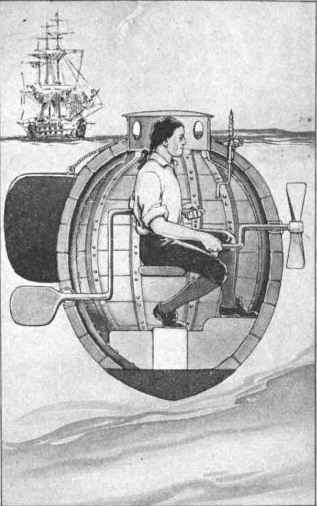
During the mid-eighteenth century, an Englishman had devised plans for a submarine, but in 1776, an American, David Bushnell, built the first workable submarine a one man, hand crank powered vessel called the Turtle, which attempted to fasten an explosive charge on the hull of the British ship the Eagle. Mechanical clocks could be found in the late middle ages, but it was an American, Eli Terry, who found a way to mass produce wooden clocks around 1800.